Skip to content

Shades and blinds get mixed up all the time. Store signs, online listings, and even some product names use the words interchangeably, which makes shopping more confusing than it needs to be. The good news is that the difference is simple once you know what to look for.
Here’s the short answer: window shades are made from fabric and move as one continuous piece. Blinds are made from hard slats, usually wood, faux wood, vinyl, or aluminum, that tilt to control light. Shades tend to look softer and insulate better, while blinds give you more precise light control and handle moisture well. The right choice depends on the room, how much light you want to manage, and the look you’re going for.
Contents
- What Is the Difference Between Window Shades and Blinds?
- Is There Such a Thing as a Faux Wood Shade?
- What Types of Window Shades Are Available?
- What Types of Blinds Are Available?
- Which Is Better for Light Control and Privacy?
- How Do Shades and Blinds Compare on Energy, Moisture, and Cost?
- Which Rooms Suit Shades, and Which Suit Blinds?
- Can You Combine Blinds and Shades?
- Find Window Shades and Blinds in Collegeville, PA
What Is the Difference Between Window Shades and Blinds?
The difference comes down to material and how they operate.
- Window shades are fabric treatments. They raise and lower as a single piece of material, either rolling up, folding, or stacking at the top. You adjust light by how far you lower them.
- Blinds are made of individual hard slats strung together with a ladder or cord system. You can raise them fully, or tilt the slats open and closed to angle light while the blind stays down.
A quick way to tell them apart: if it’s fabric, it’s a shade. If it has rigid slats you can tilt, it’s a blind.
Is There Such a Thing as a Faux Wood Shade?
No. Faux wood is a material used for blinds, not shades. Faux wood products are rigid slats made from composite or PVC materials designed to look like painted wood, and they work exactly like any other blind: they tilt.
The confusion usually comes from listings that use “shades” as a catch-all term for any window covering. If someone describes a faux wood shade, they almost always mean faux wood blinds.
One related product worth clarifying is the woven wood shade. Woven wood shades are made from natural woven materials like bamboo, reeds, and grasses. Even though they include natural fibers, they’re still shades: they raise and lower as one piece and don’t have tilting slats.
What Types of Window Shades Are Available?
Because shades are fabric, they come in a wide range of styles, textures, and opacities.
- Cellular shades: Honeycomb-shaped cellular shades trap air for insulation, making them one of the most energy-efficient options.
- Roller shades: Roller shades roll neatly onto a tube for a clean, minimal look, available from sheer to blackout.
- Roman shades: Roman shades fold into soft, tailored pleats and bring color and pattern into a room.
- Solar shades: Woven screen fabrics that cut glare and UV while preserving the view.
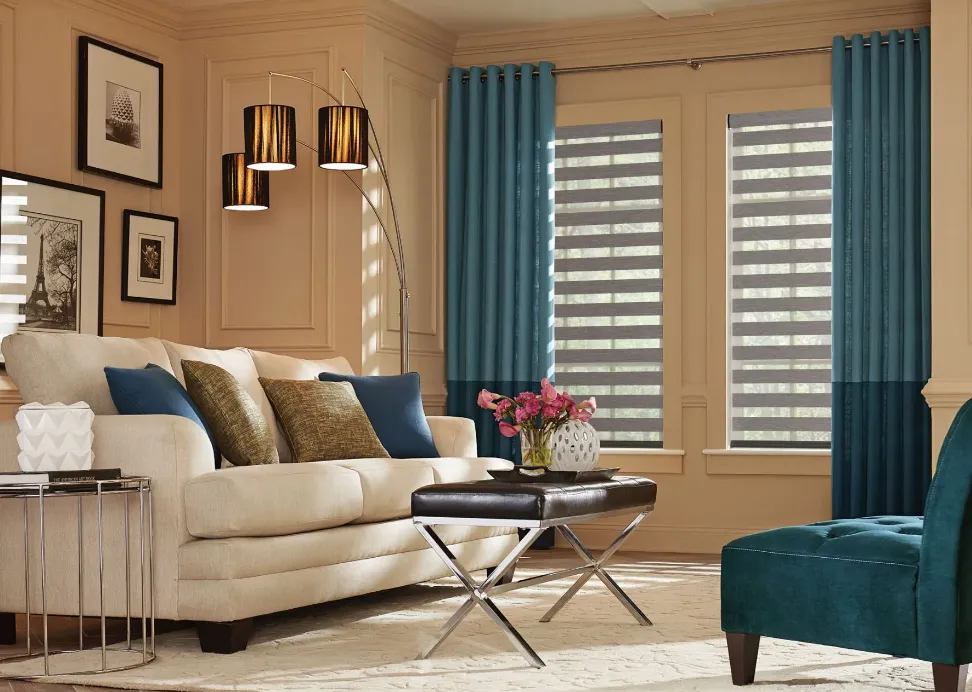
- Sheer shades: Fabric vanes between sheer layers that soften light beautifully.
What Types of Blinds Are Available?
Blinds are defined by their slat material, and each material suits different rooms.
- Faux wood blinds: Moisture-resistant, heat-stable, and affordable. A strong choice for kitchens, bathrooms, and sunny windows.
- Wood blinds: Natural wood blinds offer warm grain and stain options for living rooms, dining rooms, and offices.
- Vinyl blinds: The most budget-friendly option, great for bathrooms, laundry rooms, and rentals.
- Aluminum blinds: Slim, lightweight, and durable for a modern or practical look.
Which Is Better for Light Control and Privacy?
Blinds offer more precise light control. You can tilt slats to let light in while blocking the view from outside, which is ideal for street-facing rooms during the day. The trade-off is that small gaps between slats and along the edges let some light through, even when closed.
Window shades win on full coverage. Blackout fabrics and room-darkening liners can block nearly all light, which makes shades the stronger choice for bedrooms and nurseries. Light-filtering fabrics, on the other hand, soften daylight while keeping your privacy.
How Do Shades and Blinds Compare on Energy, Moisture, and Cost?
- Energy efficiency: Cellular shades lead here. Their honeycomb pockets help keep rooms warmer in winter and cooler in summer, a real benefit through Pennsylvania’s seasons.
- Moisture: Faux wood and vinyl blinds handle humidity far better than fabric. They won’t absorb water or hold onto mildew, so they’re the go-to for bathrooms and kitchens.
- Cleaning: Blinds wipe clean with a damp cloth. Most shades need gentle dusting or vacuuming.
- Cost: Vinyl and faux wood blinds are usually the most budget-friendly. Real wood blinds and tailored fabric shades like Roman or cellular styles tend to cost more, depending on size and fabric.
Which Rooms Suit Shades, and Which Suit Blinds?
- Bedrooms: Shades, especially blackout cellular or roller shades for better sleep.
- Living rooms: Either. Roman or sheer shades for softness, or wood blinds for warmth and light control.
- Kitchens and bathrooms: Blinds, usually faux wood or vinyl, for moisture resistance.
- Home offices: Blinds for adjustable light, or solar shades to cut screen glare.
- Large picture windows: Shades, which cover wide spans cleanly without heavy slats.
Many homes use both. A kitchen with faux wood blinds can flow into a family room with cellular shades, as long as the colors coordinate.
Can You Combine Blinds and Shades?
Yes, and layering blinds and shades in the same window is a great way to get the best of both. A common approach is a wood or faux wood blind for daily light control with a Roman shade mounted above for softness and color. See our ideas on how to layer custom window treatments for a more finished look.
Find Window Shades and Blinds in Collegeville, PA
The easiest way to choose is to see fabrics and slats side by side in your own light. Bartlett Blinds and Shutters is a veteran-owned local company that brings the showroom to your home, with custom window shades and blinds for every room, across Collegeville and Montgomery, Bucks, Chester, and Delaware Counties and Philadelphia.
Schedule your free in-home consultation or call (267) 651-0972, and we’ll help you match the right shade or blind to each window.
Frequently Asked Questions
1.What is the main difference between window shades and blinds?
Window shades are made of fabric and move as one continuous piece. Blinds are made of hard slats, such as wood, faux wood, vinyl, or aluminum, that tilt to adjust light.
2.Are faux wood shades a real product?
No. Faux wood is a blind material, not a shade. Faux wood products have rigid slats that tilt, so they’re always blinds. Listings that say “faux wood shades” are almost always describing faux wood blinds.
3.Are woven wood shades blinds or shades?
They’re shades. Woven wood shades are made from natural woven materials like bamboo and reeds, but they raise and lower as one piece and don’t have tilting slats.
4.Which is better for bedrooms, blinds or shades?
Shades are usually better for bedrooms because blackout and room-darkening fabrics block more light than blinds, which let light through small gaps between slats.
5.Which is better for bathrooms and kitchens?
Blinds, especially faux wood or vinyl. They resist moisture and wipe clean easily, while fabric shades can absorb humidity and hold onto odors or mildew.
6.Are window shades more energy efficient than blinds?
Cellular shades are among the most energy-efficient window treatments because their honeycomb cells trap air. Most blinds provide less insulation, though they still reduce heat gain when closed.